
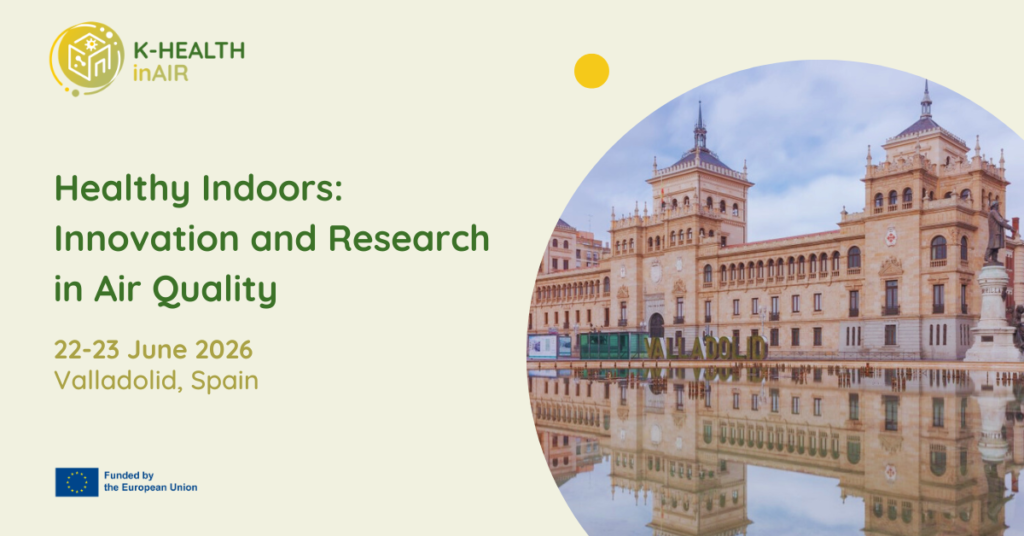
22-23 June 2026 (Monday and Tuesday)
Royal Academy of Medicine and Surgery of Valladolid (RAMYCVA)
Palacio de los Vivero (Av. Ramón y Cajal, 1, 47003 Valladolid).
Healthy Indoors: Innovation and Research in Air Quality brought together researchers, health professionals, policymakers and key stakeholders to discuss the latest advances in indoor air quality (IAQ) research and its impact on health and wellbeing.
Organised within the framework of the European project K-HEALTHinAIR, the conference provided an open scientific forum welcoming contributions beyond the project, fostering interdisciplinary dialogue between science, technology, public health and policy. Over two days, the programme addressed key topics such as continuous monitoring using low-cost sensors, exposure to chemical and biological pollutants, health effects in different indoor environments, and the role of artificial intelligence and data-driven approaches in supporting IAQ management.
The event combined scientific sessions, oral presentations and poster contributions, policy-oriented roundtables and stakeholder discussions, as well as a special session focused on community and school engagement, highlighting the value of citizen science and early awareness of indoor air quality.
The conference took place on 22–23 June 2026 at the Royal Academy of Medicine and Surgery of Valladolid, a historic venue that served as a meeting point to stimulate new collaborations, share knowledge and advance sustainable strategies to improve indoor air quality in Europe and beyond.
The programme of the conference is available here.
The Book of Abstracts is available here.