
Within the K-HEALTHinAIR project, a stakeholder consultation was performed to gather contributions from different sectors about the proposals for new regulations related to indoor air quality.
In the first stage, a stakeholder mapping was conducted, identifying entities from different areas of activity and contexts: public administrations from healthcare and environment, consumer associations, professional associations, residents’ associations, patient organizations, non-governmental organizations, scientific organizations, technology development, material suppliers, consultants, and corporations. This exercise gathered contacts from the countries represented in the consortium (e.g., Austria, Germany, Poland, Portugal, Spain, the Netherlands), reaching the final number of 73 entities. In parallel, a questionnaire was prepared with open and closed questions to understand the views of the stakeholders regarding the adequacy of current instruments framing indoor air quality and the insights for proposing new regulations. The survey was conducted in an anonymous format.
In the second stage, the stakeholders were contacted through the available institutional contacts (e.g., Communication Offices) and asked to answer the questions (timeframe: 2 months). To ensure wider participation, the questionnaire was made publicly available through a LinkedIn publication on the project account.
The survey received 32 responses from various stakeholders, including EEA Panel members and networks, international organizations (non-EU-EEA), national authorities within the EU-EEA, non-governmental organizations, universities/research institutes, and the private sector (e.g., industry, services). More than half of the participants (56%) had over 10 years of experience related to indoor air quality topics. In terms of countries, these stakeholders were based in Spain (n=13), Portugal (n=6), the United Kingdom (n=4), the Netherlands (n=2), Belgium (n=2), and Austria, Romania, Denmark, Luxembourg, and the United States, with one participant each.
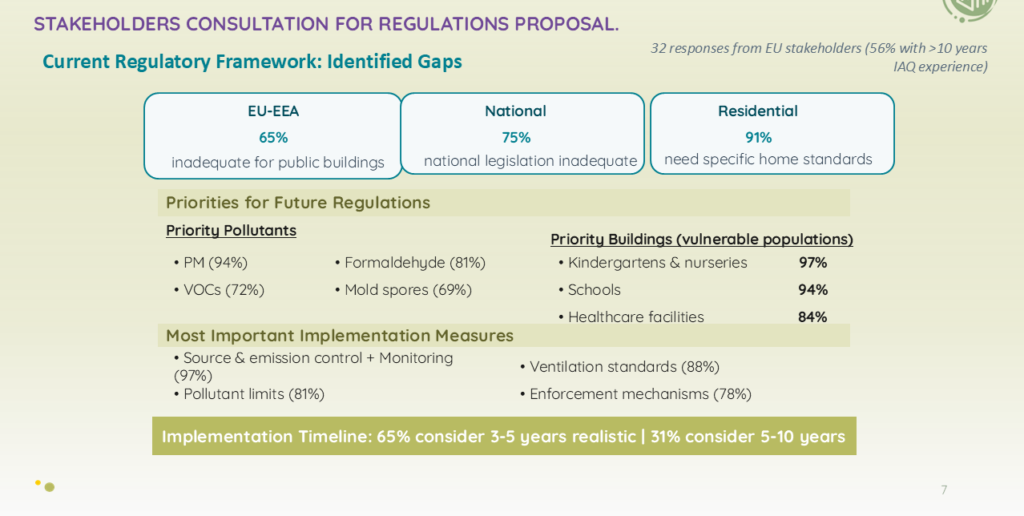
Results pointed out that stakeholders consider that the European Economic Area (EU-EEA) and the legislation available in each country do not adequately address IAQ in public buildings (65% for the EU-EEA level; 75% for the national level). Also, the results obtained indicate that specific recommendations should address IAQ in homes, with most respondents agreeing with this need (91%).
Regarding pollutants to be prioritised in future IAQ regulations, particulate matter (94%), formaldehyde (81%), volatile organic compounds (72%), mold spores (69%), and radon (53%) were the pollutants considered more important to be included in future IAQ regulations. Carbon monoxide and nitrogen dioxide did not reach the consensus above 50% of the respondents. Bacteria, endotoxins, ultrafine particles, ozone, flame retardants, perfluoroalkyl substances, and polycyclic aromatic hydrocarbons were also mentioned in reduced percentages. Regarding buildings to be prioritised, respondents emphasized the importance of vulnerable populations by choosing more kindergartens and nurseries (97%), schools (94%), and healthcare facilities (84%).
Regarding the measures deemed important for improving IAQ, the questionnaire inquired about source and emission control, ventilation standards, concentration limits for pollutants, monitoring activities, and enforcement mechanisms. Respondents considered source and emission control and monitoring activities as very important and as extremely important for improving IAQ (97%). The other measures considered in these categories, but in lower percentages: ventilation standards (88%), concentration limits for pollutants (81%), and enforcement mechanisms (78%).
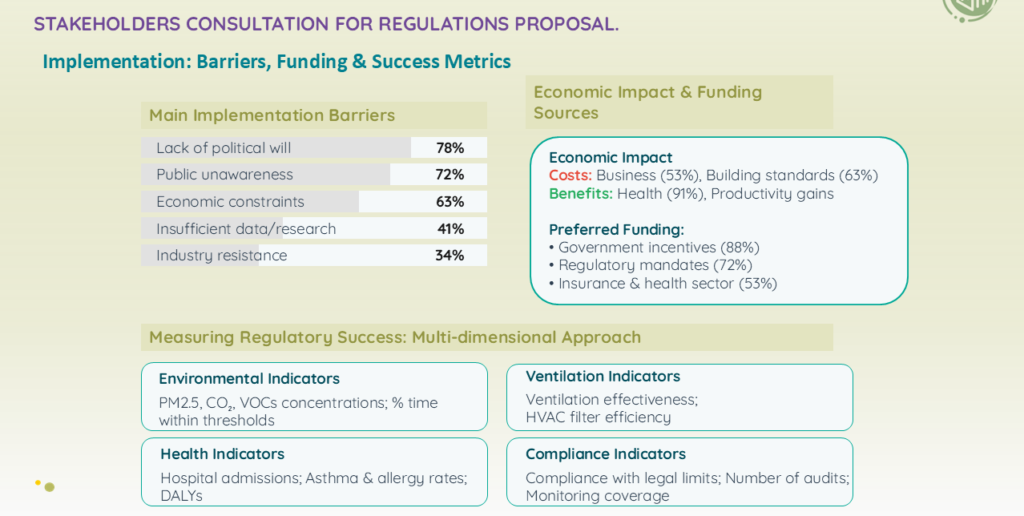
When asked for a realistic timeline for implementing new IAQ regulations in the EU-EEA, three to five years was selected by 65% of respondents, five to ten years was selected by 31% of respondents, and one to two years was selected by 3% of respondents. Regarding the barriers foreseen for the implementation of stronger IAQ regulations, the respondents chose the options in the following decreasing order: lack of political will (78%), public unawareness (72%), economic constraints (63%), insufficient data or research (41%), industry resistance (34%), lack of technology for monitoring (19%). Additionally, other aspects were also referred to by respondents: excessive and very slow bureaucracy, and the need for periodic compliance checks.
Regarding the economic impacts and funding sources associated with the implementation of stricter IAQ requirements, costs for businesses (53%) and building standards (63&) were identified in the perspective of increasing costs; however, these costs would be counter-balanced by the benefits in economic terms: health-related benefits (91%), benefits for related industries (28%) and real estate improvements (34%). Productivity gains were also mentioned positively. Regarding possible incentives or funding for the implementation of IAQ improvements, the preferences were for government incentives (88%) and for regulatory mandates (72%). Insurance and health sector incentives and utility and energy programs were chosen by 53% and 47% of respondents, respectively. Performance-based and polluter-pays incentives were also referred to as a possible source of funding.
Stakeholders were also inquired about initiatives at national level that could inform EU-EEA wide regulation. Overall, the responses highlight that while several countries have IAQ regulations, standards, or initiatives (e.g., Portugal’s national IAQ rules, Sweden’s OVK, Romania’s Strop de aer, sector‑specific safety practices), enforcement, maintenance, and follow‑up are often weak or inconsistent. Existing initiatives and organisations could inform EU‑EEA‑wide regulation, but only if accompanied by mandatory requirements, robust verification, and stronger public administration oversight.
Stakeholders identified several approaches that different organizations can support IAQ policy: providing evidence‑based data, field research, and analysis to inform realistic targets, harmonised thresholds, and performance verification methods. They can contribute technical expertise through the development and evaluation of monitoring technologies, impact‑assessment tools, epidemiological research, and health impact assessments. Their role also includes supporting legislation through standards development, implementation guidance, training, and promotion of improved ventilation and mitigation technologies. Finally, they can raise awareness, advocate for IAQ as a public‑health priority, foster collaboration across sectors, and deploy practical solutions anchored in scientific evidence and real‑world practice.
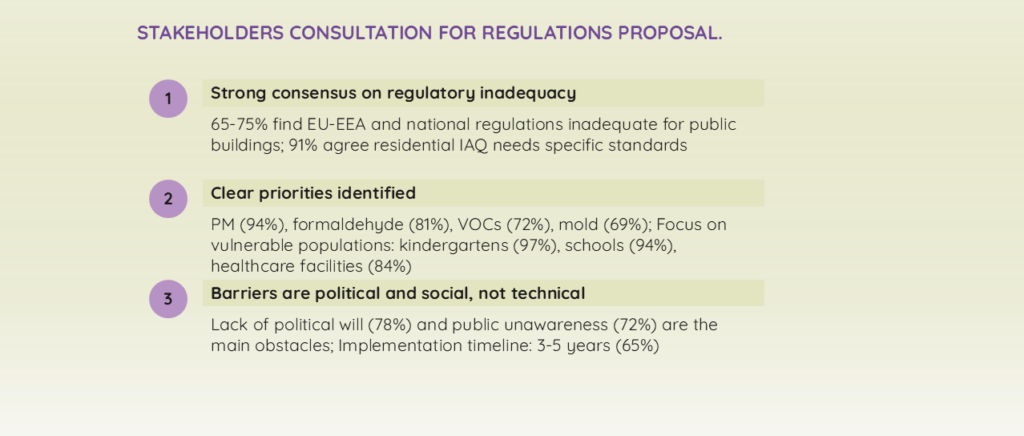
Regarding possible indicators to be used in measuring the success of IAQ regulations, it was referred that it should be measured using a combination of environmental, health, and compliance indicators supported by continuous monitoring and evaluation. Effective assessment links measured pollutant reductions with verified performance of building systems and observable improvements in occupant health and comfort. Monitoring should be sustained over time, transparent, and complemented by surveys, audits, and health data to capture both objective and subjective impacts. This integrated approach ensures that IAQ regulations deliver real, measurable public‑health benefits rather than only formal compliance. Some possible indicators were identified: