Over the past four years, K-HEALTHinAIR has worked to improve knowledge on the links between indoor air quality and health, combining monitoring, data analysis, health-related research, technological development, stakeholder engagement, education and policy-oriented work.
The project has now developed a set of results that can support different communities, from researchers and public authorities to healthcare professionals, industry actors, building managers, schools, patient organisations and citizens.
A key part of the project’s final work is the Exploitation Plan, which identifies how K-HEALTHinAIR outputs can be used, shared and further developed after the project ends.
The plan focuses on 11 Key Exploitable Results, including monitoring technologies, digital tools, scientific publications, guidelines, policy recommendations, awareness materials and technological innovations.
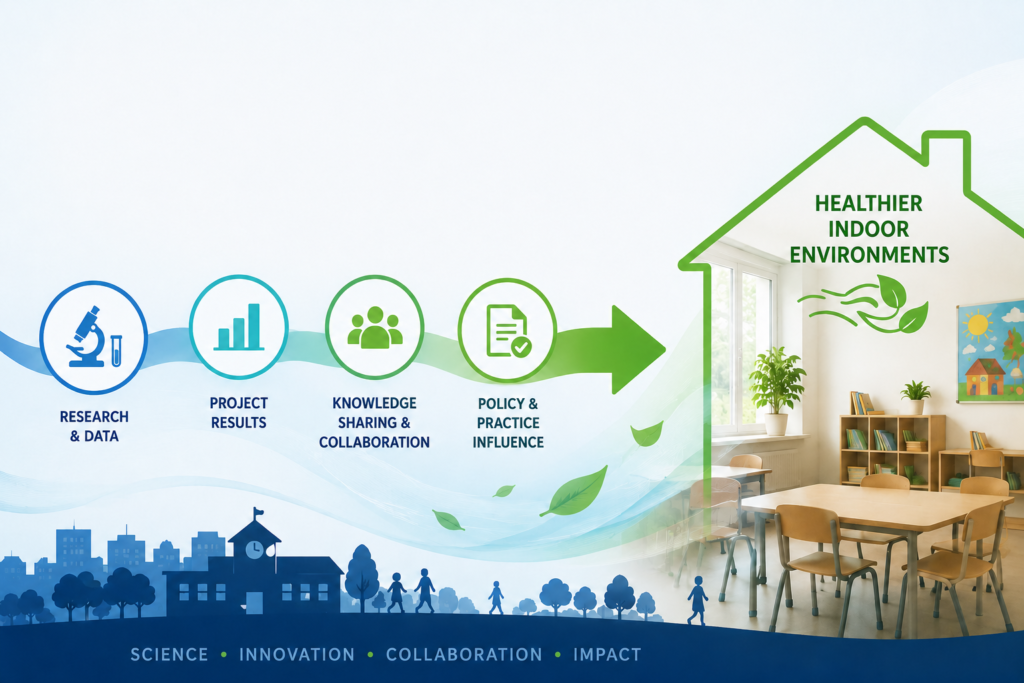
Rather than treating these results as isolated outputs, the project is looking at how they can support different pathways for impact: research, policy development, health prevention, innovation, education and practical action in indoor environments.
K-HEALTHinAIR results respond to different needs.
For researchers, the project provides evidence, data-related outputs, methods and analytical tools. For public authorities and policymakers, it offers knowledge that can support future discussions on indoor air quality recommendations, standards and governance. For healthcare and public health actors, it provides insights and resources to better communicate the links between indoor air quality and health. For citizens, patients, schools and building users, the project offers accessible materials to better understand indoor air quality risks and possible actions.
Industry and technology developers may also benefit from the project’s work on monitoring tools, data-driven approaches and innovative solutions for improving indoor environments.
The K-HEALTHinAIR Open Access Platform is central to the project legacy. It brings together two complementary components: the Knowledge Sharing Module and the Data Management Module.
The Knowledge Sharing Module provides access to educational materials, awareness resources, knowledge products and practical information for different audiences. The Data Management Module supports access to data-related resources, monitoring information and technical outputs.
Together, these modules help ensure that project knowledge can remain accessible and useful after the end of the project.
Indoor air quality is increasingly recognised as a public health and policy issue. K-HEALTHinAIR contributes to this discussion by providing evidence on pollutants, exposure scenarios, vulnerable groups, monitoring approaches, health risks and possible mitigation measures.
The project’s guidelines and policy-oriented outputs can help inform future discussions on healthier indoor environments, while its awareness and educational materials can support citizens, schools, healthcare actors and community organisations in understanding and communicating indoor air quality issues.
As K-HEALTHinAIR enters its final phase, the consortium will continue working to consolidate and promote the project’s results. This includes strengthening the visibility of the Open Access Platform, supporting the use of knowledge resources, sharing final project outputs and encouraging uptake by relevant stakeholders.
The long-term ambition is clear: to ensure that K-HEALTHinAIR results remain accessible, understandable and useful for those who can apply them in research, policy, practice and innovation.